Sunday, February 25, 2007

Pan's Labyrinth (El Laberinto del Fauno)

2006
Director: Guillermo del Toro
Staring: Ivana Baquero, Sergi López, Doug Jones

I write this review if only because of Pan’s Labyrinth winning the Academy Awards for Best Art Direction, Achievement in Makeup, and Achievement in Cinematography. It had been nominated for Best Original Screenplay, Best Foreign Language Film, and Best Original Score.

Plot:

Pan’s Labyrinth is a story set in post-Civil War Spain about Ofelia (Ivana Baquero), a young girl, who with her mother is traveling to live with her stepfather in the countryside. Ofelia is not happy about the move, but her mother says it is for the best. Interested in fantasy books, Ofelia is somewhat shocked and relieved to stumble across an ancient Faun who tells her a wondrous tale of an ancient king looking for his long lost daughter… who has happened to be reincarnated into Ofelia.

Events become tense when communist rebels being to attack around her stepfather’s country estate, as Ofelia completes the required tasks for her to enter back into the kingdom once more.

Review:

When I first saw the film, I wasn’t quite sure what to think. The music was brilliant, the acting was superb, and the set design was absolutely amazing. What bothered me at first was the conclusion. For those who have seen the film, you know what I’m talking about.

The open interpretation of the entire story was troublesome to me, and frankly I really had no idea how to react to the film without some deep thought. At one moment it’s a bittersweet tale, then the other an all out depressing story. After some deep thinking, the film is not just amazing because of the ambiguity of much of the story and the debates that stem from that, but because the story is so well crafted, I almost felt a part of it all.

Mind you, before going into this, it’s really two stories in one. It is a fantasy film and a brutal war film all in one.

Verdict: *****/*****

Tuesday, February 20, 2007

Part III: Unrated Cuts and other Marketing foolishness

In the past two years, and increasingly more and more, there seem to be an ever growing number of "unrated" DVDs on sale. First off, the term is plastered on the DVD box like it really means something. For the most part it doesn’t, but I’ll get to that later.

The Chronicles of Riddick was PG-13, if the Unrated version had been rated it would have easily have gotten a PG-13 rating, it may have been a hard PG-13 rating, but it would have been one none the less. Harold and Kumar had an unrated film with R rated content, no change in rating. Eurotrip (another R film) only huge difference in the unrated version was that it had about 90 seconds of additional nudity, which around a minute of which was “comedic” older male nudity.

Beyond that the “unrated” cover is generally worse than the regular box and makes the entire thing hideous. Okay, we get it, the only people it fools are High School students and drunken frat boys (apologies to any non-drunken, white hat wearing frat boys). The only thing it means is they didn’t bother submitting it to the MPAA. Personally, I believe any film which is not a documentary which hasn’t been rated should be restricted from sale the same way NC-17 films are (meaning that in the end the pros of submitting the film and having an extended version with *gasp* the same rating would be better financially for them in the long run).

One of the worst marketing ploys was The Bourne Identity's "explosive extended edition" which actually was a DOWNGRADE (no DTS, commentary tracks) with worthless alternate scenes that never would fit into the film or with the sequel in any instance. It makes me wish I had bought the DVD a few years ago when that edition was easy to find.

I actually refuse to buy DVDs when I know there will be an extended version in the works. I'm not fooled. I won't buy a film twice (only certain editions that I own will be replaced depending on the quality of the secondary release, such as a bare bones DVD bought in 1999 replaced by a special edition high quality transfer in 2006).

No one should be fooled by the buzz words that people use. "Collectors" (usual a regular, and only, release) "Ultimate", "Explosive" (hardly), "Special" (only if it has a crappy earlier release). On a side note, if a film is an "infini" release, it stays on the shelf, why would anyone want to make it nearly impossible to find special features, and claim it to be like a gift from God, when it's just a hyped up term that means the navigation on the DVD is impossible?

Monday, February 19, 2007

Part II: Re-cuts

This is part two of my series discussing the marketing of DVDs, and the strengths and weaknesses of the decision to go through with them.

Today I’ll write about the state of more extensive re-cutting of a film. Part of the discussion is spill over from the directors/extended cut discussion, and another part is much bigger.

Instances where the more extensive re-cut of a film has benefited the movie watching experience can be a tough thing to weigh in on. Some people may feel the original version’s flow was superior, while others believe the additions are beneficial to the overall storytelling.

I would almost hazard to say that the Lord of the Rings films are probably the most recent example of having enough material cut from a film to give it a completely new cut. The amount of good, usable footage, that still hasn’t seen the day of light is extensive, hours worth. The film that benefited the most from the entire extended version was The Two Towers, while the film that didn’t benefit at all was Return of the King. Where Two Towers helped expand, and strengthen Tolkien’s original vision of Middle Earth, Return of the King destroyed it. It contained a few additional references to the book, but many of them were half hearted additions, or were completely out of place in a film that already had half the heart of the first two.

Apocalypse Now: Redux is a film that seems split entirely down the middle as to whether the film is superior or inferior to the original. I’ve seen both, and I really can’t tell you as I’m torn both ways. The longer, “Redux” version contains a lot more story, but much of it feels almost too surreal and other parts of it feel inconsequential to the overall story which is supposed to be unfolding.

The Exorcist: The Beginning and Dominion: Prequel to the Exorcist is an interesting case. The original film “Dominion” was completed, and was then rejected by the studio. Renny Harlin then came in to film “The Beginning”, replacing 90 percent of the footage filmed. The new cut even had some completely different characters, while dropping others who were in the earlier cut. Again, I found neither cut was really spectacular, with some good things in the Harlin version (I know, gasp!), and other parts superior in the Paul Schrader version.

Superman II is the latest film to be “redone”, this time by the original director (before he was dismissed/fired/left the project), Richard Donner. The situation was much like the more recent Exorcist prequel, but overall (aside from the slight campy feel and no Brando in the “final” version) they’re exactly the same films. Many will praise this version, some of said praise is legitimate and another part of it feels too much like support based on spiteful vitriol poised directly on the man who took over as director, Richard Lester. I for one see some benefits to this newfound version of the story, but many many many problems with it. After seeing it, I realized the project was not done to make the best film possible, but to give a huge middle finger to Lester, as they almost completely cut any possible footage of his, not because it’s bad, but because “It’s Lester’s footage.” The unoriginal reuse of the first film’s copout ending only put the final nail in the coffin for this attempt.

One “new” version slated to be released sometime soon is Payback, the Mel Gibson revenge film. Apparently it drops the entire Kris Kristofferson subplot. It should be interesting to see.

Sunday, February 18, 2007

Film Marketing Part I: Director’s Cuts

I’ve been real busy lately, too busy to write any reviews, but I wanted to get something on here so return viewers would have something to read. This will be the first in a three part series. The following two will hopefully be out tomorrow and the day after that.

For some time I’ve thought about what makes a good Director's Cut and what makes a bad one, and in some instances I’m truly stumped.

Some Director's cuts just make a film better than it already was. Blade Runner, while not quite a "real" director's cut is better than the theatrical version. I know Scott wants to work on it again, but is being stopped by one of the Producers (the guy who owns Univision, the Spanish speaking channel, I think). Another (which isn't quite referred to as a Director's Cut) is Aliens. It makes the film much better. A re-cut of a film can take a movie that was average or mediocre and make it so much better.

Take Daredevil for example. The film was a PG-13 disaster which was missing overall cohesion between scenes. It felt completely chopped up. Thankfully one of the producers of the film, Gary Foster, does not have final say in what was released in the rated R version, as the new version was substantially better. Foster has been put on record about how the Director’s Cut pretty much “doesn’t exist”, and the frustration of director Mark Steven Johnson can be seen in the cutting room during various behind-the-scene specials. The director’s cut restored many scenes and actually made the confrontation with Kingpin make sense towards the end, instead of it being some loose haphazardly thrown together aside that the villain was finally “going down” for some vague, hard to connect reason.

Another film that was made much better was Star Trek: The Motion Picture. Additional effects were added, other effects (which in some respects were not able to be done on either the budget or the time constraints given to them) were reworked, and original series sound effects were added instead of the grating late 70's “futuristic” sound effects. The film was finally rounded off with a much tighter editing job thanks to director Robert Wise. Yes, for those who didn’t know Robert Wise, the man who edited Citizen Kane, directed The Day the Earth Stood Still, The Haunting, The Sound of Music, and West Side Story, directed the first Star Trek film.

A brief mention of The Chronicles of Riddick is a good example of a film that was only helped with a extended version of the film. The story was fleshed out, and the 17 minutes of additional film helped strengthen the film’s plot and characters enough to explain away any minor faults the film had in pacing and storytelling.

There are other cuts of films that apparently do more harm than good, and I can only write from the comments others have made, but on good word I direct people to the extended version of The 40 Year Old Virgin, which apparently took a well paced film and made it a bloated, somewhat directionless film.

I won’t bother mentioning any bad films that had equally miserable extended/director’s cuts, as that would be a complete waste of time. There are many other examples of good or even bad films that have had a better extended or director’s cut made of it, but I could then go on forever, and my job does not permit me to do such a thing.

Wednesday, February 14, 2007

The Umbrellas of Cherbourg (Les Parapluies de Cherbourg)

1964
Staring: Catherine Deneuve, Nino Castelnuovo
Director: Jacques Demy
Writer: Jacques Demy

Summary:

The plot of the film follows Geneviève (Catherine Deneuve) who, with her mother, sells umbrellas in the town of Cherbourg. Geneviève is in love with Guy (Nino Castelnuovo). Guy lives with his godmother and her care-giver, Madeleine (Ellen Farner). Geneviève and her mother are desperate for money. Geneviève becomes pregnant with Guy’s child before he is shipped off to fight in the Algerian War. When gone, Geneviève’s mother convinces her to marry Roland Cassard (Marc Michel), a jeweler.

Once Guy returns, years later, everything in Cherbourg is changed for him. His former life is no longer what he looks forward to, due to the loss of Geneviève. He spends all night out at sleazy bars, and sleeps with a prostitute named “Jenny”, who turns out to really be called Geneviève. That same evening Guy’s godmother dies.

The film’s final sequence is set 3 or 4 years later, with Guy finally running the gas station he always wanted to and married to Madeleine, who they have a child with named François. This last sequence is amazingly shot, and can barely be described by me as to the number of symbolic moments which occur here. Frankly any way I put it would probably destroy the film’s ending, so I’ll leave it there. I can only describe it as both a happy, and sad ending.

Review:

While I am certainly not fluent in French, this 1964 French language gem certainly didn’t lose much in translation. Initially I was hesitant to watch the film, and only stumbled across this by accident when watching Turner Classic Movies. After watching three silent movies in a row, I figured I may as well throw in the towel and give it a shot. Figuring this as Valentine’s Day, I thought that this film would be a perfect choice for a review today.

From Robert Osborne’s introduction, I found that the film was the first French musical ever in color. Also, another trivia point was that all the dialogue in the film was sung. I don’t mean in all the songs like in most musicals, but everything. From the singing between characters to the mailman dropping off the mail, everyone sings. Certainly a feat just based on that, especially since they successfully pull it off.

The film won the Grand Prix ("Grand Prize") at the 1964 Cannes Film Festival and was nominated for the Academy Award for Best Foreign Language Film in 1964, and was also nominated for Oscars in "Best Original Score", "Best Scoring", and "Best Song" (for "I Will Wait For You"). The younger readers here would recognize the song from the episode of Futurama where Fry’s dog waits outside the pizzeria.

Verdict: *****/*****

Saturday, February 10, 2007

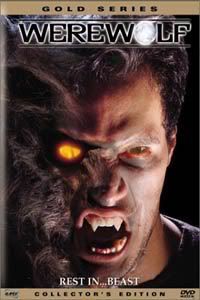
Werewolf

This review is inspired by my good friend Jonathan, who I’m heading down to Richmond to visit for the weekend.

Photobucket - Video and Image Hosting

1996
Staring: no one of interest
Director: Tony Zarindast

Summary:

The film starts off with a dig at an archeologist site. One of the "key" characters is Joel (played by Joe Estevez, Martin Sheen's brother). For no reason at all a fight ensues and one of the diggers is injured, apparently cut on the bones of a supposed "werewolf." Needless to say that werewolf dies, and after a few mishaps, Yuri (Jorge Rivero) is successful with "creating" a living "werewolf," and of course people end up dying.

Review:

Overall the plot does not make a whole lot of sense, though since I watched the highly edited MST3k version it's hard to tell what was supposed to be "in" the film vs. what was presented before the audience.

Not much can really be said about Werewolf, at least not a whole lot of positive things.
This 1996 film, yes, 1996. There is no way this film could have been filmed less than 5 years before it was released. Everything about this film screamed “80s”.

Not surprisingly, the main thing that makes the film so bad is the compete lack of clarity in the way the story is presented. But then again, it really doesn't matter, everything about this film screams "don't watch." Only check out the MST3k version. For the love of God, please only attempt to watch it any other way way. You’d probably be sorry.

By the way, it is number 96 on the bottom 100 films on the IMDb.

Verdict: */*****

Wednesday, February 07, 2007

The Ring

2002
Staring: Naomi Watts, Martin Henderson, Brian Cox
Director: Gore Verbinski

Copyright Dreamwork Pictures


Summary:

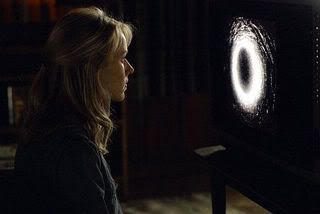
Journalist Rachel Keller (Naomi Watts) decides to investigate what caused the mysterious death of her niece (Amber Tamblyn). She soon finds that 3 of her niece’s friends all died at the same time she did that very evening. A rumor spreading around the school is that a mysterious cursed video they watched killed them.

Rachel soon discovers the cabin that her niece stayed at, and discovers an unmarked video... which watches in the very cabin her niece stayed. After a terrifying phone call Rachel is convinced that she has 7 days to live and must unravel the mystery surrounding the tape, especially after her son, Aiden watches it. With her friend Noah (Martin Henderson), she must quickly find out how to break the curse, before their time is up.

Review:

The Ring was both a blessing to modern horror and the very thing that ended up damning the entire genre. The film is one of the few horror films to be actually well developed and well crafted, without having to hold onto the crutch of being gory for the sake of being gory. The unfortunate side effect was that, since this film was pg-13, it opened the door for producers to start shoveling out the current schlock that’s out there now. The difference between those crummy films and this one is that this film has atmosphere and a tone that doesn’t lend itself to “low budget cinematic garbage”

Much of the success of the atmosphere of the film leans directly on Gore Verbinski. The must unfortunate thing was that he bailed on the sequel and moved on to do the bloated Pirates franchise. The result of this move was a very mediocre Ring Two, but that’s another review.

Verdict: ****/*****

Monday, February 05, 2007

The Producers

The Producers:

2005
Staring: Nathan Lane, Matthew Broderick
Director: Susan Stroman

Review:


"How can a play which has been hailed and loved by so many people turn into such a mediocre film?" This is the first thing that popped in my mind about 25 minutes into watching this. I’ve never seen the play but I’ve seen the original, and based off of this alone, the original like with most things (besides the Maltese Falcon) is better.

Hopefully most people have seen at least one of the incarnations of the story so as my explanation can be short. Two con-men devise a way to make a bundle off of a theater production flop by making the worst play ever made. There, now that I’m done with that onto my issues with the film.

The film fell completely flat because it was directed like it was a play. Most of the camera techniques were bland, and the acting was what you'd expect in a play.

This of course is not to say that the acting in a play is bad, but that it is a completely different performance an actor is trying to project. Nathan Lane and Matthew Broderick both present good stage performances, but very lousy theatrical film performances in this film. Flat, boring, and as if they were projecting to a few hundred people, and not a movie screen. There was no originality in the presentation of the film, sets were what you'd expect from a play, mostly 2 dimensional, Spartan, and uninspired.

One of the major complaints from critics about this film was that it lacked any directorial direction (yes, I realize what I just said). If that was their intention, neither the critics nor audience understood it as such. This might explain why the "biggest" Broadway play barely grossed half its budget, while other modern musicals like Chicago grossed upwards to 7 times that much.

Generally you can tell how a film is filmed, even laymen like me and most other people can. You can tell the techniques used (even subtle ones) compared to say, crummy direct-to-video or other TV-movie schlock like the Sci-fi Channel's original movies. It was almost as if they just set up cameras off stage and filmed a Broadway performance. That's generally not how you want to film 45 million dollar movie, ever. The film wasn't "real" enough to be believable, nor was it "surreal" enough to forgive the lack of "real world" characteristics. The set design and especially the direction was bland as water. You'll find more interesting camera shots in, say, a 1932 film, when cameras were much more limited.

And bland is about as nice of a thing as I can say.

Verdict: **/*****

Sunday, February 04, 2007

Brides of Dracula

Brides of Dracula

Staring: Peter Cushing, Yvonne Monlaur
Director: Terence Fisher
Year: 1960

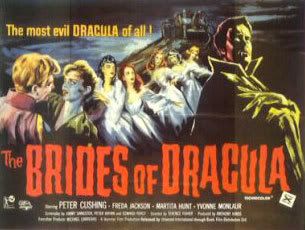
Film poster of Brides of Dracula


Review:

It seems that only some people know about Hammer Films, maybe it's an age thing for most, so for those who do not, Hammer was a big movie studio who went about making a great many horror films during the late 50s all the way into the 70s. The Brides of Dracula is a 1960 entry into Hammer's horror collection.

This is the first sequel - though more of a semi-sequel - to Hammer's very own 1958's Dracula. The only returning character is that of Van Helsing (Peter Cushing). The film did not star Christopher Lee as Dracula, and not that I want to give anything away, but I feel I must warn people expecting to see him due to the title of the film - Dracula doesn't appear at all in the film.
Speaking of the title, they weren't really his brides anyway, but I digress.

The setting for this film is Transylvania. Danielle (the lovely Yvonne Monlaur) is traveling to an all girl school. Along the way she stays at a castle, where she helps Baron Meinster (David Peel), apparently held prisoner by his own mother, escape. Woops, big mistake, and soon after this event the young girls at the school are soon preyed upon. Luckily to everyone in harms way, Van Helsing is on his way to save the day.

I can't say this film is fantastic, or groundbreaking, but is a decent vampire film. The film can be found in the Hammer Horror Series box set.

Saturday, February 03, 2007

The Penalty – 1920

The Penalty – 1920

Staring: Lon Chaney
Director: Wallace Worsley

Review:

The film begins with Blizzard (later played by Chaney) as a child, in bed after an accident, with a new doctor trying to figure out if amputation is necessary or not. Unfortunately, he makes the decision before a more seasoned doctor arrives, who later discovers that the operation was probably unnecessary. The doctors decide to cover this up, but Blizzard hears this and no one believes him.

20 or so years later (though they’d be driving 1919 models in the early 40s), Blizzard has become a hardened criminal, a mob leader of San Francisco, who’s finally caught up with the doctor who made him lose his legs. And now that Doctor's gonna pay.

Chaney's performance in "The Penalty" was amazing, playing a hardened, detestable criminal. He did an amazing job portraying an amputee, but I’m not so sure about the rumors that he suffered spine/back damage due to the leather straps he used to keep his legs back. Unfortunately I found the resolution of the film to be a bit lame and too much of copout for such a great screen character. But great film none the less.

I also wasn't a huge fan of some of the music for the version that was shown on TCM, some of it was great, while other parts were too heavy on the 80s/early 90s style synth-"crashing" music.

Verdict:
Film: ***(1/2)/*****
Music: */*****

Friday, February 02, 2007

Mission

A few months ago I tried the whole blogging thing out. It was a lot of fun and I enjoyed it. Unfortunately after a month of blogging I was completely burned out, and somehow, through either the fault of myself, the co-writer, or just some really ticked off jerk got the entire thing deleted. A month of hard work gone. It's taken me this long to finally realize that I enjoyed it, and enjoyed it far more than constantly posting on the IMDb boards all the time.

I don't claim to be an expert on any subject. I'm just a guy with a blog. With that said I hope that anyone who reads these entries enjoys my reviews, commentaries, and general thoughts of the film and television industries. For the most part I will try to rate films based on others in the genre, so don't think that just because I gave some schlocky comedy a slightly better rating than a serious drama means that I think "Taxi Driver" was worse than "Super Troopers" (granted this isn't how I feel about these, but it was the first two films to pop into my mind).

So with all of that said, enjoy!